



Transformative Journey: A Client’s Experience with Trichotillomania
Few moments are as meaningful as witnessing a client make progress in their journey with trichotillomania in Boston. This story shares one client’s personal experience—from daily hair pulling to a place of greater control, healing, and renewed confidence.
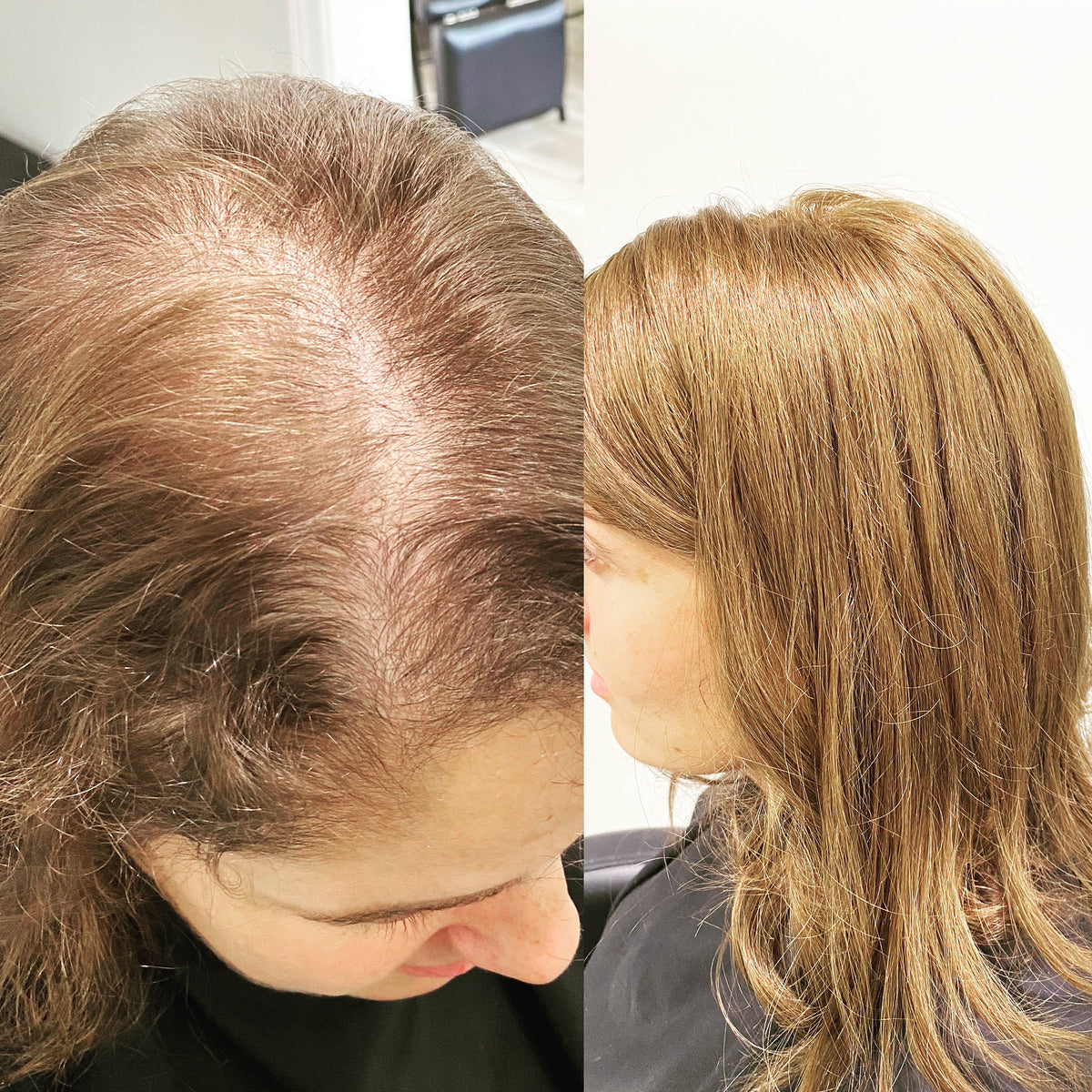
Over time, with the right combination of support, strategies, and consistency, she was able to reduce pulling behaviors and allow her hair to recover. Today, she wears her natural hair with pride, reflecting the progress she has worked hard to achieve.
Stories like hers—and the continued referrals we receive from physicians and therapists—highlight the value of a compassionate, well-rounded approach. When emotional support, behavioral tools, and practical solutions come together, meaningful change becomes possible.
Understanding Trichotillomania and the weight it carries
Client “A” asked me to share her story anonymously to help others facing similar challenges.
Trichotillomania—often shortened to “Trich”—is a body-focused repetitive behavior (BFRB) characterized by recurrent, hard-to-resist urges to pull out one’s hair.
For many, the behavior can feel soothing in the moment yet lead to distress, shame, and visible hair loss afterward.
When she first visited our salon, she had total hair loss on the crown from repeated pulling. We chose to tie in a customized hair system to protect the vulnerable area and support hair regrowth while addressing the emotional cycle connected to pulling.
The first appointment: beginning with protection and care
Stress at school, family pressure, and the intense urge to pull had become intertwined in her daily life.
She described pulling as a brief sense of control, followed by a wave of regret and desperation.
We implemented a hair system to cover the top of her head and provide a physical barrier, while also opening space for mindset and behavioral change.
A hair system is a non-surgical, custom piece that provides coverage where hair is missing, restoring appearance while acting as a protective barrier and motivational aid during recovery.
By clarifying each step, we aimed to reduce anxiety and create a predictable routine.
Early on, she returned for several two-week check-ins because she tried to reach under the hairpiece to pull. Understandably, she doubted whether the system would work for her. At each visit, we coached her to “go with the flow,” reminding her that the barrier was there to interrupt pulling and give her scalp a chance to heal. The first months were challenging, but by the fourth month she found herself thinking less about her hair. The hairpiece became a steady cue to pause, breathe, and not touch—an anchor that supported both hair recovery and mental health. What would it feel like to have a gentle reminder in place right when urges arise?
Noticing regrowth: visible progress and growing confidence
With consistent full-maintenance visits, she began to see two to three inches of growth under the system. That tangible progress shifted her mindset—she decided to trust the process.
As her bangs grew out, we left them outside the system, added soft highlights, and created a bright “money piece.” Watching her hair come back, strand by strand, she stood a little taller and smiled more often. The mirror no longer reflected loss; it showed possibility and resilience.
Preparing for college: transitioning from a system to her own hair
A year later, as she entered senior year of high school, she worried about college life—staying active, social, and confident without relying on a full hairpiece.
Together we made a no-pressure pact: over the coming year we would gradually focus on her own hair growth, and if we needed to, we could return to a system.
By the summer before college, she had approximately eight inches of her own hair. We removed the hair system to test whether she could maintain progress without it and added gentle pull-thru hair extensions on the sides to blend shorter areas into her natural length. We also used a few hair extensions as an added barrier, since clients typically do not pull on them. By the end of summer, her hair was long, full of movement, and truly hers.
She left for college with a few extensions and no hair system. We scheduled visits roughly every three months. Each check-in, she shared that her hair felt “too beautiful to pull on.” That phrase became her mantra, a simple truth that reflected both healthy hair growth and stronger coping strategies.
Could finding your personal mantra help you stay grounded when stress builds?
What made the difference for her?
At a recent visit—now as a college senior—I asked what mattered most. She listed, in order of importance:
- Once her hair grew, she didn’t want to pull and start over—visible progress protected her progress.
- While wearing the hairpiece, she paid less attention to her hair and focused on stress management skills.
- She attends therapy to help cope with anxiety and learn tools for urge reduction.
- She loves to support others with the same condition, which gives her purpose and accountability.
- She embraces college life and no longer wants to live in the pulling cycle.
These themes highlight the value of layered support: protective styling, behavioral tools, therapeutic care, and community. Which of these steps resonates most with your own journey?
Practical steps and gentle strategies you can try
From her experience, several actions proved helpful:
- Use a protective barrier (hair system or extensions) to interrupt pulling.
- Set frequent, predictable check-ins.
- Practice stress-management techniques such as journaling or relaxation breathing.
- Partner with a therapist to address anxiety and develop competing responses.
- Celebrate small wins, like a quarter inch of growth.
In therapy, Habit Reversal Training (HRT) builds awareness of triggers and pairs each urge with a competing response—an intentional, incompatible action such as briefly clenching a fist or engaging the hands to ride out the urge.
Competing responses are tailored to the individual and can be practiced discreetly throughout the day.
Modalities like Cognitive Behavioral Therapy (CBT) and Dialectical Behavior Therapy (DBT) teach coping strategies, reshape unhelpful thought patterns, and support emotion regulation related to pulling.
Simple scalp-health measures—consistent cleansing, gentle products, and healthy daily routines—help create an environment that supports regrowth alongside behavioral work.
These are not quick fixes; they are sustainable, compassionate practices that support both scalp health and emotional well-being. What one small step could you commit to this week?
A relatable, hypothetical moment
Imagine a student sitting in a quiet dorm room, feeling that familiar surge of tension before an exam. Her hand drifts toward her scalp, then pauses as her fingers touch a smooth extension—an intentional barrier.
She exhales, opens her notebook, and texts a friend from her support circle. Minutes later, the urge passes. This simple scene captures the heart of recovery: practical tools, mindful pauses, and support when you need it most. Can you picture how a similar plan might fit into your daily routine?
Closing thoughts: compassion, commitment, and hope
I share Client “A’s” experience, with her permission, to offer encouragement to anyone affected by trichotillomania. Progress is rarely linear, but with the right combination of protective styling, skill-building, therapy, and patience, meaningful change is possible.
For parents, it’s important to remember that your child’s story is still unfolding. With consistent support, understanding, and a collaborative approach, real progress can happen over time.
Every step forward—no matter how small—matters. With compassion, commitment, and the right tools in place, it is possible to move toward greater control, regrowth, and renewed confidence.
Support is available when you’re ready.
👉 Book your free trichotillomania consultation
Note: Unlike alopecia areata, fungal infections, or other forms of hair loss, trichotillomania is a behavioral condition in which hair is physically removed. Our approach addresses both the emotional and physical aspects—using protective systems to create a gentle barrier, support scalp health, and strengthen hair while reinforcing sustainable coping strategies.


